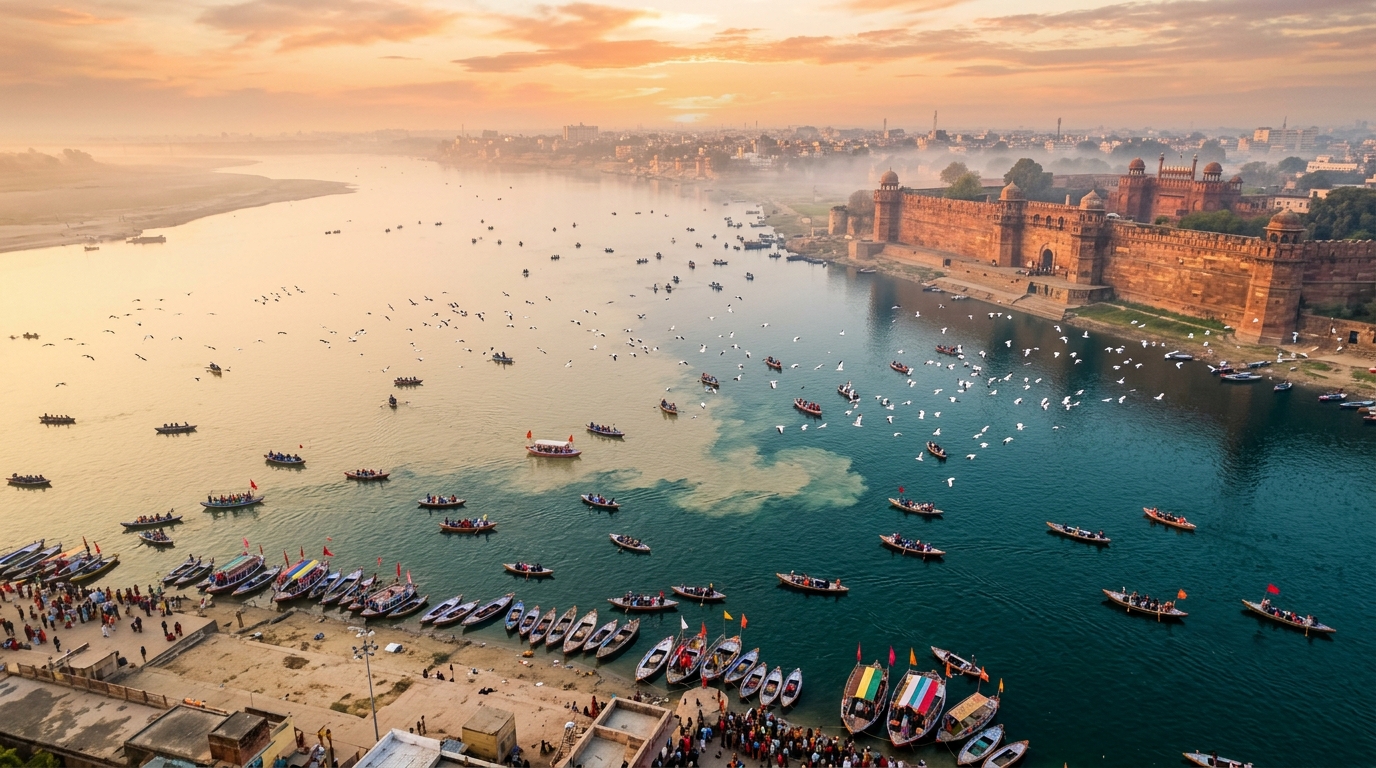
प्रयागराज
Prayāgarāja • Prayagraj
The Supreme Sovereign King over all earthly and celestial pilgrimages
From "Pra" (supreme) + "Yaj" (sacrifice) — The altar of Brahma's first cosmic creation rite
The cosmic confluence of three celestial rivers: Ganga, Yamuna, and subterranean Saraswati
The epic intellectual crucible of Mimamsa philosophy and Kumarila Bhatta
प्रयागे सर्वतीर्थानि निवसन्ति युगे युगे । गङ्गायमुनयोर्मध्ये यस्तु स्नाति नरोत्तमः ॥ स सर्वपापनिर्मुक्तो याति विष्णोः परं पदम् । तीर्थराजं नमस्कृत्य मुच्यते भवबन्धनात् ॥
Prayāge sarvatīrthāni nivasanti yuge yuge | Gaṅgāyamunayormadhye yastu snāti narottamaḥ || Sa sarvapāpanirmukto yāti viṣṇoḥ paraṁ padam | Tīrtharājaṁ namaskṛtya mucyate bhavabandhanāt ||
In Prayag reside all sacred pilgrimages across every cosmic age. That noble seeker who immerses in the waters between the Ganga and Yamuna is emancipated from all past karma and attains the supreme abode of Lord Vishnu. Bowing before Tirtharaj Prayag breaks all earthly bondage.
The Millennia of Tirtharaj Prayag
In the Matsya and Padma Puranas, Prayagraj is crowned as "Tirtharaj" — the King of all holy places. When Sage Markandeya questioned Lord Vishnu about the imperishable ground during universal deluge, the Lord revealed that even when the cosmos dissolves beneath the waters of Pralaya, the holy ground of Prayag and the celestial Akshayavat tree remain steadfast as the sanctuary of the Supreme Consciousness.
Lord Brahma’s Cosmic Prakrishta Yajna
Immediately after conceiving the cosmic order, Lord Brahma chose this sacred confluence between the celestial rivers to perform the first supreme sacrificial rite (Prakrishta Yajna). From "Pra" (supreme) and "Yaj" (sacrifice), the eternal name "Prayāga" was inscribed into the cosmic records.
Lord Rama at Maharishi Bharadwaj’s Hermitage
During their 14-year forest exile, Lord Rama, Devi Sita, and Lakshmana arrived in Prayag and spent the night at the intellectual and spiritual hermitage of Maharishi Bharadwaj. The sage guided them to cross the Yamuna River upon a wooden raft to settle at Chitrakoot.
The Nectar of Immortality & The Kumbh Mela
When the ocean of milk was churned, celestial bird Garuda carried the Kumbha (pot) filled with divine nectar (Amrita). Drops spilled at four sacred terrestrial points: Prayagraj, Haridwar, Ujjain, and Nashik. Every 12 years, when Jupiter enters Taurus and the Sun and Moon enter Capricorn, the Maha Kumbh Mela convenes at Sangam.
Emperor Harsha’s Grand Moksha Parishad
Chinese traveler Xuanzang witnessed the 75-day Moksha Parishad where King Harsha Vardhana distributed all royal treasury wealth to monks, ascetics, and impoverished citizens at the Sangam sands, donning a worn garment and rejoicing that all transient possessions had been surrendered to the divine.
The Sacred Shrines of Prayag
From the water junction of the Triveni to the subterranean Lete Hue Hanuman Ji and the immortal boughs of Akshayavat.
Triveni Sangam Holy Confluence
The Meeting of Ganga, Yamuna & The Invisible Saraswati
The holiest confluence on earth. The pale yellowish silt of Ganga visibly merges with the deep crystalline turquoise of Yamuna, while subterranean Saraswati joins in spiritual radiance. Bathing here during Magha dissolves lifespans of karma.
Devotees hire wooden rowing boats from the banks of Kila Ghat or Sangam Ghat to reach the sacred wooden bathing platforms positioned precisely at the point of convergence where the water currents dance together.
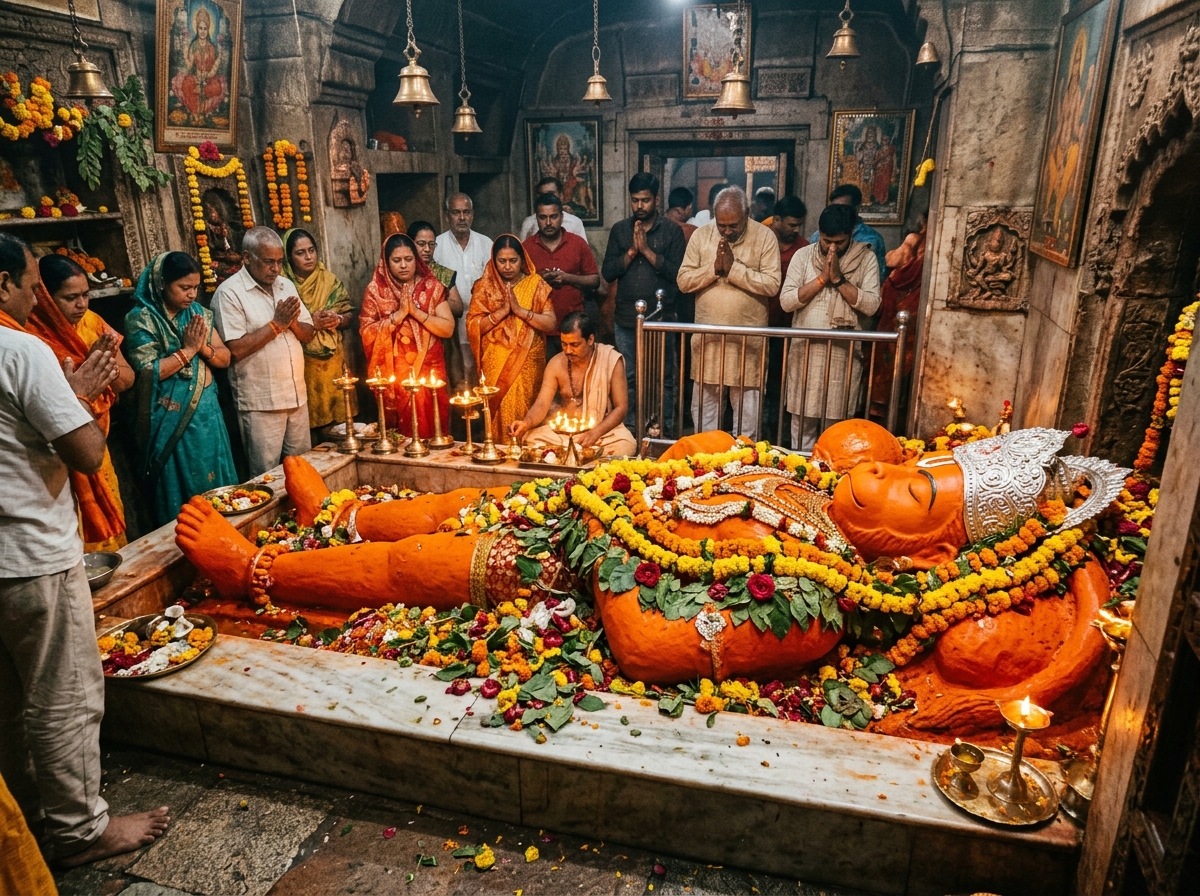
Shri Bade Hanuman Mandir (Lete Hue Hanuman Ji)
The Subterranean Reclining Deity Submerged by Ganga Every Monsoon
The only temple in the world where Lord Hanuman is worshipped in a full subterranean reclining (sleeping) posture. Legend holds that after Lanka was burned, Hanuman rested here to cool his cosmic exhaustion in the holy waters.
The 20-foot idol lies 8 feet below ground level, entirely coated in sacred vermillion sindoor. Every year during high monsoon, Mother Ganga rises into the sanctum to perform "Ganga Snan" — bathing the feet and crown of Hanuman before receding back to her banks.
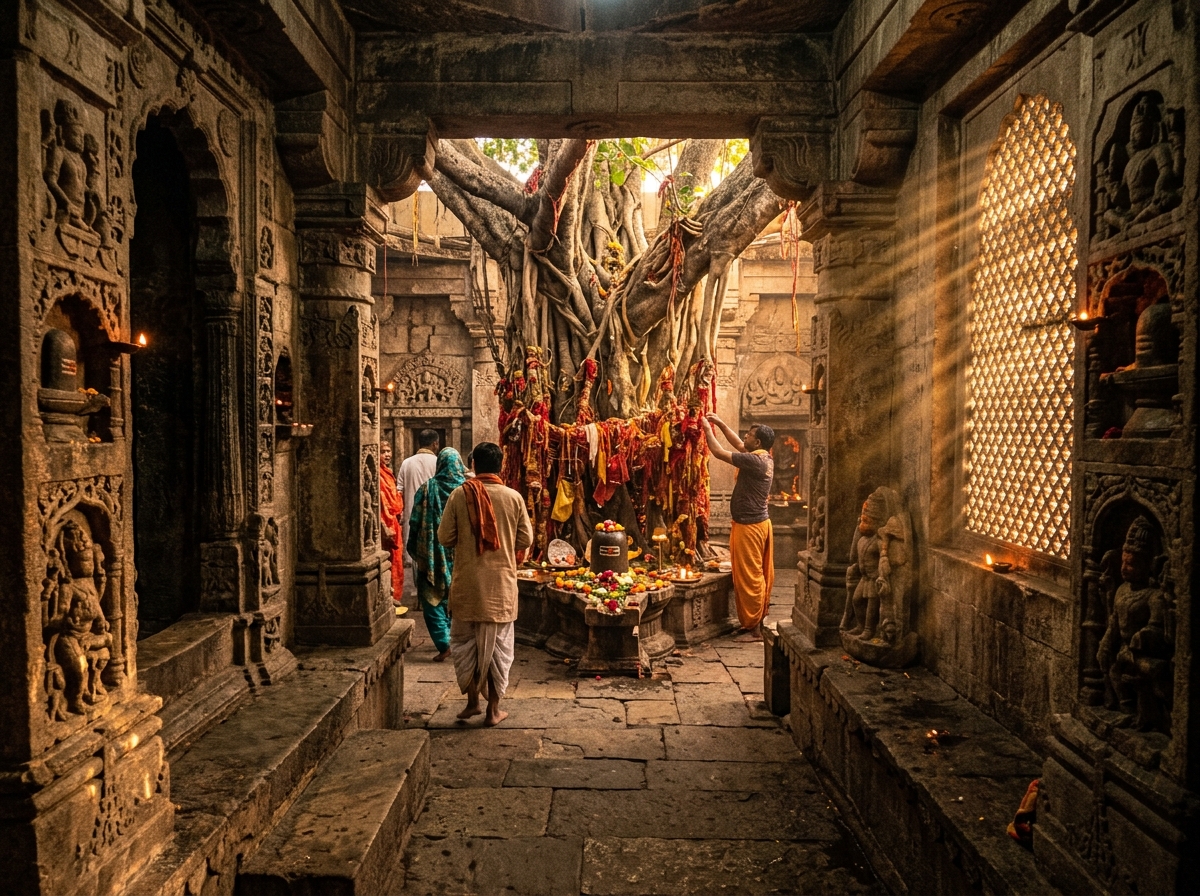
Akshayavat & Patalpuri Temple
The Indestructible Celestial Banyan Tree Surviving Cosmic Dissolution
Mentioned by Valmiki, Kalidasa, and Xuanzang. The tree is considered immortal; Sage Markandeya beheld Lord Vishnu resting as a divine infant (Bal Mukunda) upon a single leaf of Akshayavat while the universe dissolved into water.
Enshrined deep in the subterranean stone corridors of Patalpuri Temple, pilgrims tie sacred red threads (Mauli) to the consecrated branches, praying for the immortality of their lineage and liberation from cycle of rebirth.
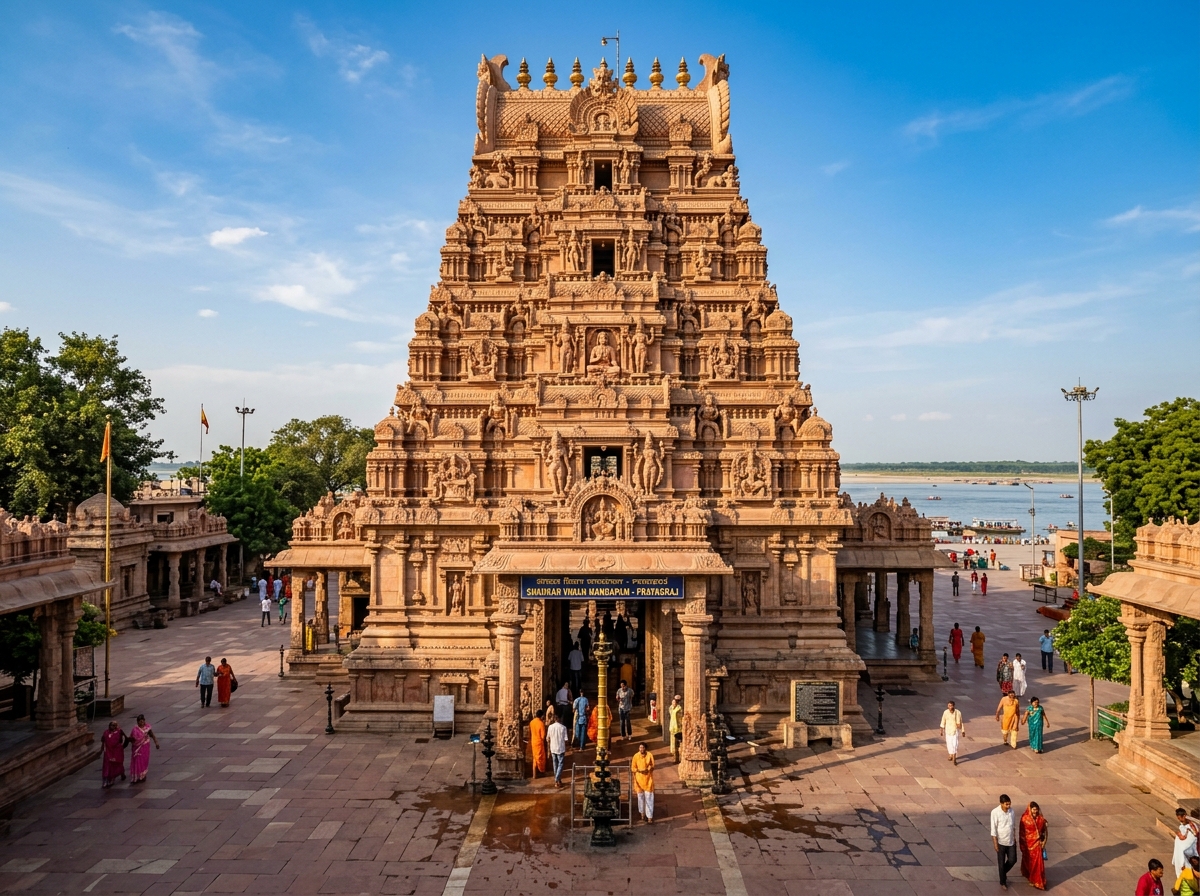
Shankar Viman Mandapam
130-Foot Multi-Tiered South Indian Gopuram at the Banks of Sangam
Built under the auspices of Jagadguru Shankaracharya of Kanchi Kamakoti Peetham (Sri Chandrasekharendra Saraswathi Swamigal), harmonizing North and South Indian spiritual traditions on 16 grand pillars directly facing the Triveni Sangam.
Four distinct levels house Kamakshi Devi, Adi Shankaracharya with 108 stone inscriptions, Lord Balaji with 108 Divya Desam replicas, and the supreme Sahasra Linga (one thousand lingas carved into a singular granite pillar).
Maa Alopi Sankari Devi Shaktipeeth
Where Sati’s Fingers Vanished: Sanctuary of the Invisible Goddess
One of the celebrated 51 Shaktipeeths and 18 Maha Shaktipeeths. Unlike traditional temples, there is no stone idol here; devotees worship a sanctified wooden palanquin (Doli) draped in crimson silk over a square stone well.
The name "Alopi" derives from "Alopa" (vanished/unseen). Legend recounts that the last remnants of Sati’s mortal fingers fell here and dissolved into pure luminous energy, teaching seekers to contemplate the formless Divine Mother.
Maharishi Bharadwaj Ashram
The Ancient University of 10,000 Vedic Rsis & Astronomers
The legendary hermitage where Sage Bharadwaj authored the ancient aviation treatise "Vaimānika Shāstra" and Ayurvedic dispensations. In the Ramayana, Bharadwaj was described as hosting entire royal retinues using his yogic siddhis.
Located near the Colonelganj district, the tranquil complex preserves ancient Shiva shrines including Anandeshwar Mahadev, sandstone statues of the Sapta Rishis, and tranquil gardens where the spiritual vibrations of Vedic chanting still resonate.
The Unseen: Legends of the Confluence
The sharp thermal boundary separating the currents, the underground Rigvedic Saraswati aquifer, and the monsoon flood devotion of Hanuman.
Standing on a wooden boat at the Sangam, one observes an astonishing optical and hydrodynamic phenomenon: a razor-sharp, visible line dividing the water for over 2.5 kilometers. On the north runs River Ganga—pale, yellowish, fast-flowing, and heavily laden with glacial silt; on the south runs River Yamuna—deep crystalline greenish-blue, slower, and denser. Due to differing water densities, temperatures, and silt concentrations, they travel parallel without fully mixing for miles.
In allegorical scriptures, this visual contrast represents the confluence of Bhakti (Ganga, white and devotional) and Karma (Yamuna, dark and active), meeting with Jnana (the invisible Saraswati, representing hidden wisdom).
Take a boat ride during early morning calm water; dip one hand in the Ganga current and the other in the Yamuna current to feel the perceptible temperature difference.
How to Reach Prayagraj: Travel Hubs
By Flight (Air)
Prayagraj Airport (IXD / Bamrauli)Modern airport terminal with daily non-stop flights from New Delhi, Mumbai, Bengaluru, Hyderabad, and Bhopal.
By Train (Rail)
Prayagraj Junction (PRYJ) & Subedarganj (SFG)Headquarters of North Central Railway. Hub for Vande Bharat Express, Prayagraj Express, and major trans-Indian trunk routes.
Local Sangam Transit
Kila Ghat, Arail Ghat & Sangam BandhaE-rickshaws operate from all railway stations to Fort Bund (Bandhwa). Regulated boatmen ferry pilgrims to the confluence.
The Flavors & Heritage Treats of Prayag
Allahabadi Surkha Guava (GI Tagged)
World-famous apple-red fleshed guava with exquisite sweetness, distinct aroma, and medicinal vitamin-rich pulp grown in the fertile silt orchards of Kaushambi and Phaphamau.
Netram Kachori, Sabzi & Desi Ghee Jalebi
An iconic culinary institution serving crisp hing (asafoetida) urad dal kachoris with spiced potato and pumpkin curry, finished with piping hot saffron jalebis simmered in pure ghee.
Dehati Rasgulla & Loknath Street Food
Freshly fried dark-caramelized soft mawa rasgullas soaked in warm green cardamom syrup, enjoyed along with rabdi-falooda and samosas in the medieval labyrinth of Chowk.
Inquiries for Pilgrims to Tirtharaj
Sacred Confluence Snan Guidelines
1. The Three Sacred Dips
At the wooden platform in the center of Sangam, take three ceremonial dips: first honoring Ganga, second Yamuna, and third invoking Saraswati for transcendental wisdom.
2. Surya Arghya & Veni Daan
Offer water directly to the rising sun facing east. Married couples traditionally perform the sacred rite of Veni Daan to invoke lifelong auspiciousness.
3. Bade Hanuman & Akshayavat
Immediately following the Sangam dip, proceed directly to Bade Hanuman Mandir to receive vermillion blessings, followed by the immortal Akshayavat tree in the fort.