काशी
Kāśī • Varanasi
From root "Kāś" — To shine, illumine with supreme consciousness
The Forest of Supreme Bliss planted by Lord Shiva and Parvati
The Realm Never Abandoned by Shiva even during universal dissolution
काशी विश्वेश्वरं देवं गङ्गां भागीरथीं तथा । नमामि शिरसा नित्यं सर्वपापप्रणाशिनीम् ॥ वाराणस्यां हि यद् दृष्टं नान्यत्र तत् क्वचिद्भवेत् । अविमुक्ते तु संसारे मोक्षैकनिलयं परम् ॥
Kāśī viśveśvaraṁ devaṁ gaṅgāṁ bhāgīrathīṁ tathā | namāmi śirasā nityaṁ sarvapāpapraṇāśinīm || Vārāṇasyāṁ hi yad dṛṣṭaṁ nānyatra tat kvacidbhavet | Avimukte tu saṁsāre mokṣaikanilayaṁ param ||
I bow my head continually to Lord Vishweshwara in Kashi and to Mother Ganga, the dissolver of all sins. What is witnessed in Varanasi cannot be found anywhere else; in this Avimukta realm lies the singular sanctuary of ultimate liberation.
The Chronology of the Sacred
Mark Twain famously wrote: "Benares is older than history, older than tradition, older even than legend, and looks twice as old as all of them put together." In Hindu cosmology, Kashi is not simply a city on the northern plains of India—it is a cosmic power center (Mahashmashana) resting directly upon the trident of Lord Shiva.
The Eternal Pillar of Light (Jyotirlinga)
When Brahma and Vishnu contested supremacy, an infinite, blazing pillar of light pierced across all planes. Shiva emerged from this Jyotirlinga in Kashi, declaring it the center where spiritual light (Kāsha) shines forever.
The Wheel of Dharma & Intellectual Crucible
King Ajatashatru held philosophical symposia here recorded in the Brihadaranyaka Upanishad. In 528 BCE, Gautama Buddha walked to nearby Sarnath to turn the Wheel of Law (Dhammacakkappavattana Sutta).
Adi Shankara and the Chandala Encounter
Jagadguru Adi Shankaracharya composed his monumental commentaries (Bhashyas) at the Ghats of Varanasi. Here, confronted by Shiva disguised as an untouchable Chandala with four dogs (the four Vedas), Shankara realized the absolute non-duality of the Self and sang the "Manisha Panchakam".
Queen Ahilyabai Holkar Resurrects Vishwanath
After repeated demolition of the holy sanctum over centuries, the saintly Queen of Malwa, Ahilyabai Holkar, rebuilt the current Kashi Vishwanath temple structure. Later in 1839, Sher-e-Punjab Maharaja Ranjit Singh donated 1,000 kilograms of pure gold to gild the temple spires.
Sacred Portals of Darshan
Each threshold preserves a distinct cosmic vibration—from the unbroken pyres of Manikarnika to the royal gold spires of Vishwanath.

Kashi Vishwanath Temple
Ruler of the Universe & Taraka Mantra Giver
The cosmic center of Shaivism. Tradition holds that Shiva himself whispers the Taraka Mantra into the ears of all who breathe their last here, securing instant liberation from the cycle of reincarnation.
Standing on the western bank of the sacred Ganges, the temple has stood at the crossroads of Indian devotion for millennia. The recently consecrated Vishwanath Corridor now connects the sanctum directly to the flowing river.

Manikarnika Ghat
The Eternal Pyre of Liberation
The primordial cremation ground where the fire has not extinguished for over three millennia. Here death is stripped of dread and recognized as the triumphant return of Atman into Brahman.
Legend says while Shiva danced, an earring (Manikarnika) fell into a well dug by Vishnu with his Chakra. Bathing in Manikarnika Kund and viewing the unbroken flames is believed to dissolve lifetimes of karmic bondage.

Dashashwamedh Ghat & Maha Aarti
Where Lord Brahma Sacrificed Ten Celestial Horses
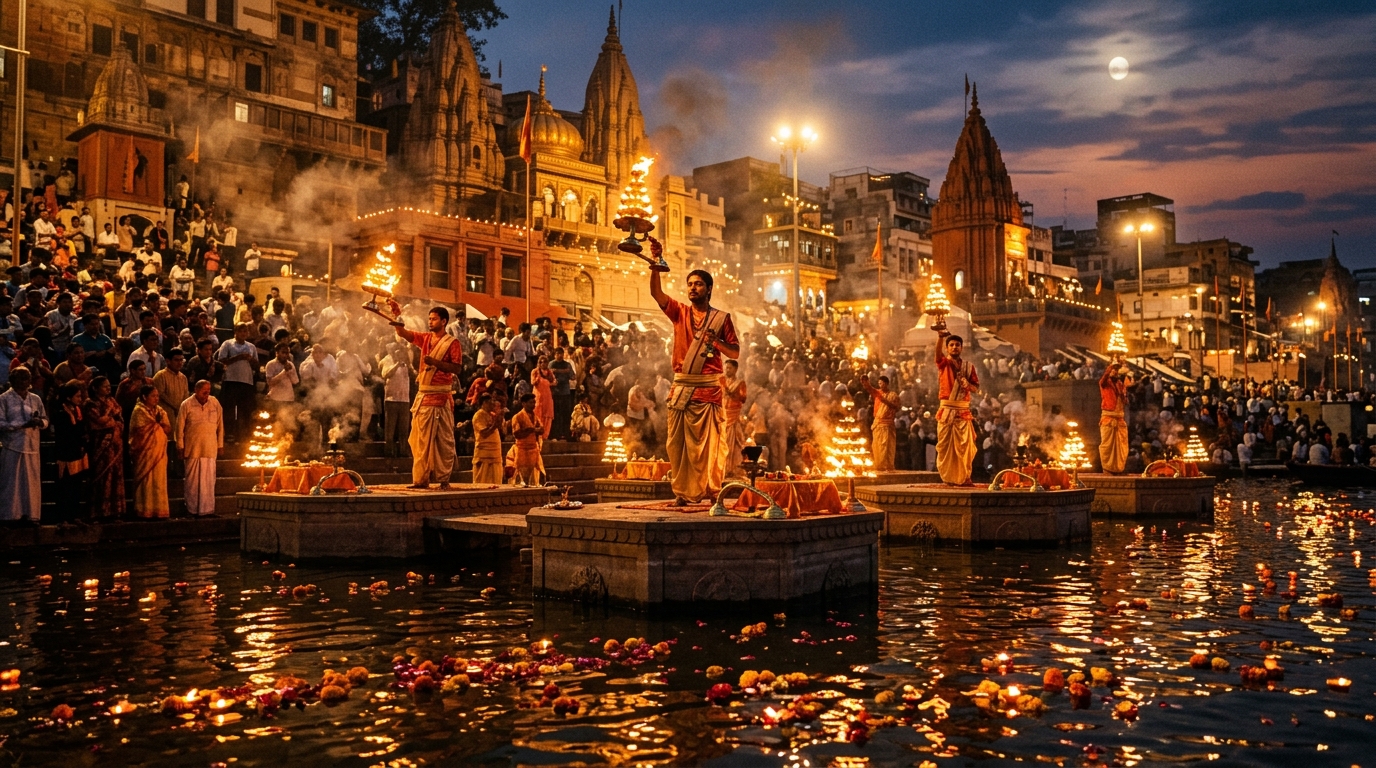
The most vibrant Ghat in Varanasi. Each evening, seven young Vedic priests lift multi-tiered bronze lamps weighing 4.5 kg, harmonizing conch shells, incense, and synchronized stotras in worship of the sacred Ganga.
Lord Brahma performed the sacred Dashashwamedha sacrifice here to welcome Shiva back to Kashi. The tiered stone steps fill with thousands of devotees floating marigold diyas onto the moonlit river current.

Assi Ghat & Subah-e-Banaras
Confluence of Sword, Sun and Mystics
The southernmost landmark where the mythical Assi stream meets the Ganga. Famous for "Subah-e-Banaras"—dawn Vedic chanting, classical Hindustani music, sunrise Yajna, and outdoor Yoga on stone platforms.
Goswami Tulsidas breathed his last near this Ghat after composing the immortal Ramcharitmanas. It is the preferred haven for ascetics, artists, philosophers, and seekers meditating as dawn breaks over the eastern river sandbar.

Kotwal Kal Bhairav Temple
Fierce Warden & Karmic Magistrate of the Holy City
Ancient tradition dictates that no pilgrim can stay in or leave Kashi without obtaining the blessings and permission of Kal Bhairav, who absorbs and pardons all past negative karmas.
Enshrined with a silver face adorned with garlands of yellow marigolds and carrying a divine trident, Kal Bhairav dispenses "Bhairavi Yatana" — burning away lingering soul conditioning so one is ripe for liberation.

Sarnath & Dhamek Stupa
Where the Wheel of Universal Compassion was Set in Motion
Located 10 km north of Varanasi, here Gautama Buddha preached the Four Noble Truths and the Eightfold Path to his first five disciples in the Deer Park (Rishipatana).
The colossal 43.6-meter high cylindrical Dhamek Stupa marks the exact spot of this first sermon. Sarnath is also where Emperor Ashoka erected the Lion Capital, now the National Emblem of India.
The Unseen: Legends in the Alleyways
Underneath the bustling riverfronts lies an esoteric grid: subterranean sun vortexes, temples tilted beyond Pisa, and four centuries of unbroken ascetic fires.
While Italy’s famous Leaning Tower of Pisa tilts at barely 3.99 degrees, this breathtaking 19th-century Nagara-style stone temple tilts at an incredible 9 degrees! For 7 to 8 months every year, its sanctum sanctorum remains entirely submerged underwater, yet the sanctum structural integrity remains intact without sinking.
Local lore attributes its construction to a wealthy royal servant who sought to repay his debt to his mother ("Matru-Rina"). Upon finishing, he proudly boasted that he had cleared his debt. Hearing this pride, the temple tilted instantly, reminding mortals that a mother’s debt can never be discharged.
Hire a small hand-rowed wooden dinghy during late winter or summer when water recedes to touch the intricately carved ribbed Shikhar stone spires.
How to Reach Varanasi: Transit Gateways
By Flight (Air)
Lal Bahadur Shastri Int'l Airport (VNS)Direct daily flights from New Delhi, Mumbai, Bengaluru, Hyderabad, Kolkata, Ahmedabad, and international charters.
By Train (Rail)
Varanasi Cantt (BSB) & Banaras (BSBS)Served by Vande Bharat Express, Rajdhani, Shiv Ganga Express, and Kashi Vishwanath Express. DDU junction is 18 km away.
Local Travel (Ghats & Galis)
Godowlia & Maidagin Traffic HubsVehicles cannot enter the narrow medieval Galis. Walk on foot or take battery-operated E-rickshaws to Godowlia Chowk.
The Flavors & Master Weaves of Banaras
Banarasi Malaiyo (Winter Saffron Dew Froth)
A cloud-like dessert made exclusively in winter by churning raw milk left overnight under morning dew, infused with pure Kashmiri saffron, cardamom, and sliced pistachios.
Pure Katan Handloom Silk Weaving
Centuries-old GI-tagged weaving tradition blending Persian zari with Hindu mythological motifs (Bel, Paisley, Kadwa) on traditional wooden pit looms.
Banarasi Paan & Tamatar Chaat
Magahi betel leaf wrapped with fragrant gulkand and spices, paired with hot spicy tomato-potato chaat simmered in pure desi ghee.
Essential Inquiries for Pilgrims & Travelers
Answers to the most queried aspects of Kashi’s darshan timings, sacred rituals, and spiritual lore.
Sacred Etiquette & Pilgrim Code
1. Sacred Dawn Boat Ride
Embark by wooden hand-rowed dinghy from Assi Ghat at 5:15 AM before sunrise. Witness the rising sun bathe the crescent sandstone steps in liquid amber.
2. Manikarnika Sanctity
Strictly refrain from photography or videography at Manikarnika and Harishchandra Ghats. Maintain quiet contemplative silence out of reverence for departing souls.
3. Kal Bhairav Sanction
Conclude your spiritual sojourn by seeking the blessings of Kal Bhairav (Kotwal of Kashi) and receiving the consecrated black protective thread (Kala Dhaga).